Attic ventilation is one of the most overlooked factors in roof health — and poor airflow is quietly behind some of the most expensive repairs we see in South Jersey homes. After more than 20 years replacing roofs and repairing attic damage across Gloucester County, I can tell you that many of the problems homeowners blame on old shingles or storm damage actually trace back to a ventilation issue that’s been building for years. At JAM Building & Renovations, we’re TAMKO Pro Platinum Certified and inspect attic ventilation on every roofing project. This guide explains why airflow matters so much and what you can do about it.
What You’ll Learn
- Why Attic Problems Sneak Up on Homeowners
- What Causes Attic Ventilation to Fail
- How to Check Your Attic Ventilation
- How Proper Ventilation Protects Your Roof and Your Home
- Why South Jersey Homeowners Choose JAM Building & Renovations
- Frequently Asked Questions
- Next Steps
Why Attic Problems Sneak Up on Homeowners
You probably don’t think about your attic often — and that’s why ventilation problems get so expensive. Your attic isn’t dead space. It’s a critical buffer zone that keeps your roof deck close to the outdoor temperature year-round. When that system breaks down, the consequences hit your roof, your energy bills, and your wallet.
Homeowners across Gloucester County, Camden County, and Burlington County typically don’t discover ventilation problems until something visible goes wrong: ice dams along the roofline, shingles curling years early, mold in the attic, or unexplainably high energy bills. By then, damage has been accumulating for months or years. Over 90% of American homes have underperforming attic ventilation, and South Jersey’s humid summers and freezing winters make the consequences especially severe.
What Causes Attic Ventilation to Fail
In our 20-plus years working on roofs across Gloucester County and South Jersey, we’ve found attic ventilation failure comes down to three root causes — and most homes have at least one.
Blocked or Insufficient Intake Vents
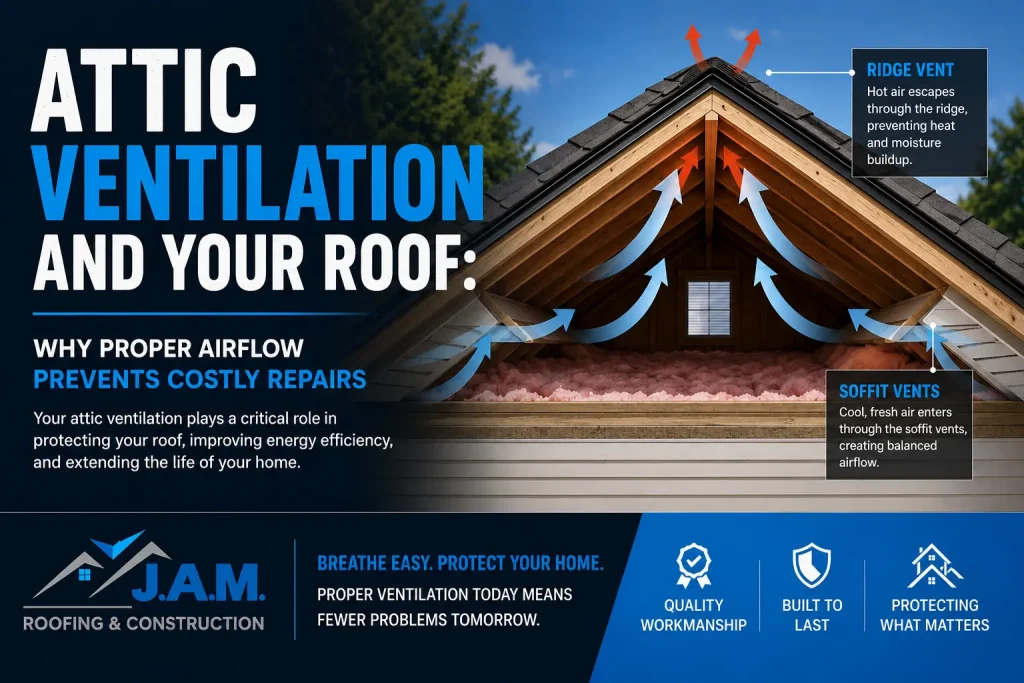
Your attic ventilation works on a simple principle: cool air enters through soffit vents at the eaves, rises as it warms, and exits through ridge or exhaust vents near the peak. The problem starts when soffit vents get blocked — insulation pushed too close to the eaves, paint covering vent screens, wasp nests, or debris. Without intake, the system stalls and warm, moist air gets trapped. Older homes in Swedesboro, Woodbury, and Mullica Hill frequently have this problem because original vent openings were undersized for later insulation upgrades.
Imbalanced Exhaust and Intake
Even when both intake and exhaust vents exist, they need to be balanced. The standard is one square foot of net free vent area per 150 square feet of attic floor space, split equally between intake and exhaust. Many South Jersey homes have either too much exhaust and not enough intake, or the reverse. Some have multiple exhaust types (ridge vents plus gable vents plus powered fans) that work against each other, creating short circuits rather than the continuous eave-to-peak sweep your attic needs.
Air Leaks from the Living Space Below
The third cause is warm, humid air leaking from your living space into the attic through gaps around recessed lights, plumbing stacks, electrical wiring, attic hatches, and furnace flues. Even well-ventilated attics can’t compensate for major air leaks. This moisture-laden air condenses on the cold roof deck in winter — creating the exact conditions ventilation is supposed to prevent. Homes throughout Gloucester County, Burlington County, Camden County, and Salem County built before modern air-sealing standards are especially prone.
How to Check Your Attic Ventilation
You can perform a basic assessment yourself. Here’s what to look for:
- Check your soffits from outside. Look under the eaves. Are vent openings visible and clear, or painted over and blocked?
- Look at your roofline. A continuous ridge vent along the peak is good. Only small box vents or no exhaust vents at all means your system may be undersized.
- Go into the attic on a hot day. If it feels above 110-120 degrees when it’s 90 outside, ventilation is likely inadequate.
- Look for moisture signs. Dark stains on the roof deck underside, damp insulation, frost in winter, or visible mold all indicate poor airflow.
- Check insulation near the eaves. If insulation is tight against the roof deck at the soffits, it’s likely blocking intake vents.
Homeowners in Haddonfield, Voorhees, Cherry Hill, Deptford, Moorestown, and Harrison Township who catch these issues early avoid far more expensive repairs down the road.
How Proper Ventilation Protects Your Roof and Your Home
Fixing attic ventilation isn’t glamorous, but the payoff is enormous. Here’s what balanced airflow actually prevents:
Ice dams in winter. When attic heat melts snow unevenly, melt water refreezes at the cold eaves and creates dams that force water under shingles. A properly ventilated attic stays within five to ten degrees of outdoor temperature, preventing uneven melting. This is critical in South Jersey where freeze-thaw cycles are relentless.
Premature shingle failure. A poorly ventilated attic can reach 150 degrees in summer, baking shingles from below and causing them to curl, crack, and lose granules years early. Proper ventilation extends shingle life and protects your warranty — most manufacturers require adequate ventilation.
Mold and wood rot. Trapped moisture creates ideal conditions for mold on the roof deck, rafters, and insulation, eventually leading to structural wood rot. Balanced ventilation continuously flushes moisture out before it condenses.
High energy bills. A superheated attic forces your AC to work harder. In winter, heat escaping into the attic means your furnace runs more. Ventilation and air sealing work together to lower energy costs year-round.
At JAM Building & Renovations, we assess attic ventilation on every roofing project. If your system is underperforming, we correct it during roof replacement — adding baffles, upgrading soffit and ridge vents, and sealing air leaks. As TAMKO Pro Platinum Certified installers, we follow manufacturer specifications that protect both your roof and your warranty.
Why South Jersey Homeowners Choose JAM Building & Renovations
For over 20 years, JAM Building & Renovations has been the roofing contractor families across Gloucester County, Camden County, Burlington County, and Salem County trust for honest assessments and lasting results. Our “Start AND Finish On Time” commitment means your roof project stays on schedule. We’ve earned a 4.8-star Google rating with 33 reviews and were named Swedesboro’s Best General Contractor of 2025.
JAM is fully licensed in New Jersey (#13VH08660000), Pennsylvania (PA148690), and Delaware (2019101357). With 100% financing available, critical roof and ventilation repairs don’t have to wait.
As Joe Aulenbach shared: “JAM did a fantastic job. Not only did it come out better than we could have imagined, but they were also so great at working with us on an affordable price. Every single person on this team is top of the line.”
Frequently Asked Questions
How do I know if my attic ventilation is adequate? Check for excessive heat in summer (above 110-120°F when it’s 90 outside), moisture or mold signs on the roof deck, and whether soffit vents are clear and unblocked. A professional inspection during a roofing assessment is the most reliable method.
Can poor attic ventilation void my roof warranty? Yes. Most shingle manufacturers, including TAMKO, require adequate attic ventilation as a warranty condition. If your ventilation is insufficient, damage caused by heat or moisture may not be covered.
What’s the right amount of attic ventilation? The general standard is one square foot of net free vent area per 150 square feet of attic floor space, split evenly between intake (soffit) and exhaust (ridge) vents. JAM ensures every roofing project meets or exceeds this standard.
Do ice dams mean I need a new roof? Not necessarily. Ice dams are primarily a ventilation and insulation problem, not a roofing material problem. Correcting airflow and sealing air leaks often eliminates ice dams without a full roof replacement.
Does JAM handle ventilation upgrades during roof replacement? Yes. JAM assesses and corrects attic ventilation on every roofing project. This includes adding soffit baffles, upgrading ridge and exhaust vents, and sealing air leaks — ensuring your new roof performs as intended.
What financing does JAM offer for roofing projects? JAM offers 100% financing on all projects. Ask about our current promotion: 10% off Roofing, Siding, and Remodeling projects.
Next Steps
Your attic ventilation directly affects how long your roof lasts, how much you spend on energy, and whether you’ll face ice dams, mold, or premature shingle failure. If you’re planning a roof replacement — or haven’t had your ventilation assessed — make airflow part of the conversation.
Call (856) 579-5987 for a free roof and ventilation assessment. Andy will personally inspect your attic and roof system and give you straightforward recommendations. Visit jambuildingandrenovations.com or stop by 1252 Kings Highway, Swedesboro, NJ 08085. We serve homeowners throughout Gloucester, Camden, Burlington, and Salem Counties.
Ask about our current promotion: 10% off plus 100% financing available.
About the Author
Andy McFadden is the Owner and Founder of JAM Building & Renovations, serving South Jersey homeowners since 2004 with expert roofing, siding, attic ventilation, kitchen remodeling, bathroom renovations, and full-service construction. As a TAMKO Pro Platinum Certified installer, Andy brings over 20 years of hands-on roofing expertise. Recognized as Swedesboro’s Best General Contractor of 2025 and backed by a 4.8-star Google rating.